-
- 13 Nov
What if your wallet could stop you from signing a bad trade before you click confirm?
That question reframes the primary tension in modern DeFi wallet design: convenience versus informed consent. For power users in the US who move significant capital across EVM chains, «convenience» often means automatic network switching, rapid DEX interactions, and hardware-wallet integrations. «Informed consent» means precise visibility into what a transaction will do to your balances, approvals, and exposure before you sign. Rabby Wallet — a non-custodial, multi‑chain wallet built by DeBank — places transaction simulation and pre‑transaction risk scanning at the center of that trade-off. The result is not perfect safety; it is a different set of trade-offs that matter when you’re managing liquidity pools, yield positions, and cross‑chain flows.
This piece examines the mechanism Rabby uses, why that matters in practice, where it breaks, and how to think about choosing a wallet when your threat model includes both smart‑contract bugs and human mistakes. If you want a concise installation or overview, there’s a single hub with official links and resources linked here; the rest of this article focuses on the operational logic and realistic limits of the product.
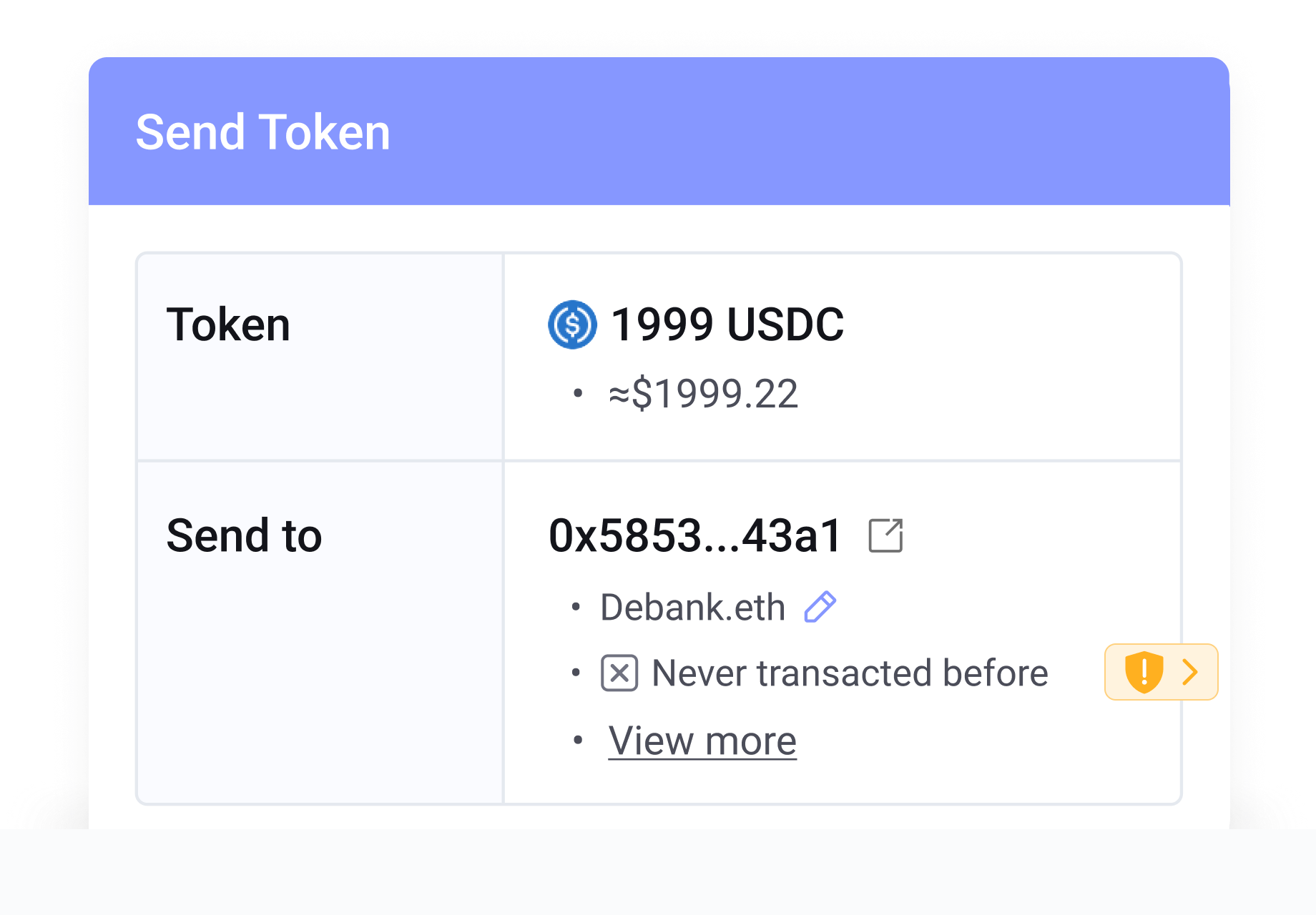
How Rabby’s transaction simulation and risk engine actually work — a mechanism view
At its core Rabby adds a pre‑signing layer: when a dApp asks the wallet to sign a transaction, the wallet simulates that transaction locally or via a node to compute estimated token movement and gas costs. The simulation shows estimated balance changes, which transforms a blind cryptographic signature into an informed economic decision. On top of this, Rabby runs a risk scan: it compares the target contract and requested approvals against a corpus of flagged addresses (previously exploited contracts, phishing contracts, or suspicious patterns) and surfaces warnings if a match or a heuristic trigger appears.
Mechanistically this is straightforward but powerful. The simulation converts state transition (what the chain will look like) into a deterministic preview; the security engine overlays metadata and heuristics. The wallet’s approval revocation tool then lets you reverse past trust relationships by revoking ERC‑20 allowances. For users who regularly connect to new dApps, these features reduce two common classes of loss: accidental approvals that leave unlimited allowances open, and signing transactions that call unexpected contract code because you misunderstood the UX.
Why those mechanisms matter to DeFi power users
For advanced users the practical benefit is not merely a reduced risk of outright theft — it’s improved decision quality. Consider three scenarios: (1) pulling LP tokens from a DEX where the UI shows your token returns but the underlying contract reissues a different token; (2) accepting a token approval prompt that gives unlimited allowance to a new aggregator; (3) bridging assets to a chain with no gas token funded. Rabby’s simulation and revocation tools give immediate, transaction‑level feedback for (1) and (2) and a cross‑chain gas top‑up option for (3). That materially shortens the feedback loop between «what I think will happen» and «what will happen on chain.»
There are secondary operational wins too: automatic network switching removes an annoying but real source of failed transactions; hardware wallet support preserves the high‑assurance signing model many institutions and serious users prefer; multi‑sig and enterprise integrations (Gnosis Safe, Fireblocks, Amber) let teams preserve custodial practices while using Rabby’s UX and simulation layer.
Trade‑offs and limitations you must accept
No tool eliminates risk entirely. Rabby’s strengths derive from simulation and metadata; they do not change the fact that smart contracts are fallible and new attack vectors emerge. A past incident illustrates this: in 2022 a Rabby Swap contract was exploited for roughly $190,000. The team responded by freezing the contract, compensating victims, and improving audits — a useful reminder that a security posture is process plus code plus response, not a single feature.
From a user perspective, important boundary conditions include the lack of an in‑wallet fiat on‑ramp and no native staking UI. If your workflow assumes buying crypto with a debit card inside the wallet or delegating to on‑chain validators without leaving the extension, you’ll need external services or additional tooling. Also, simulation is only as good as the data sources and models behind it: complex multi‑call transactions, on‑chain randomness, or implicit off‑chain oracle behaviors can make estimates approximate rather than exact.
Finally, there’s a behavioral trade‑off: detailed warnings and simulations improve information but also increase cognitive load. Power users can benefit, but only if they actually read and act on the output. Simulation can create a false sense of security for users who treat warnings as binary «safe/unsafe» signals; many risks (like social engineering or private key compromise) sit outside the wallet’s scanning scope.
Comparative context: where Rabby sits among EVM wallets
Rabby competes against wallets like MetaMask, Trust Wallet, and Coinbase Wallet. The key differentiators are simulation, built‑in approval revocation, automatic network switching, and extensive hardware wallet compatibility. MetaMask is ubiquitous and integrates with many dApps, but lacks a native, consistently surfaced transaction simulation layer. Institutional players might prefer custodial services with compliance features, but Rabby’s integrations with multi‑sig and enterprise custody solutions make it a reasonable bridge between self‑custody UX and institutional controls.
Choosing a wallet is a layered decision. Use this heuristic: if you trade often across DEXes, interact with many freshly deployed contracts, and value explicit allowance control, a simulation‑first wallet like Rabby raises your baseline safety. If your risk model emphasizes fiat access and in‑wallet staking, you’ll need supplemental services. For institutional flows, check the exact integration points (API access, session management, multi‑sig policies) rather than assuming feature parity.
Decision‑useful heuristics and a mental model to reuse
Here are three practical heuristics to apply when evaluating Rabby or any wallet as a DeFi power user:
1) Transaction as hypothesis: treat every transaction as a causal hypothesis about state transitions. Use simulation to test the hypothesis; if the preview doesn’t match your expectation, don’t sign.
2) Approval hygiene: audit and revoke allowances quarterly or after major allocations. A native revocation tool removes friction and therefore reduces the chance you’ll postpone this maintenance step.
3) Multi‑layer defense: combine hardware signing, multi‑sig for institutional pools, and wallet simulation. These layers address different failure modes: key compromise, single‑contract bugs, and user error respectively.
What to watch next — signals that would change the calculus
Watch for three signals that would meaningfully affect the wallet’s value proposition: broader adoption of transaction simulation as a standard (which would push the industry baseline upward); any new, unresolved exploit patterns that target simulation tooling itself (for example, gas‑price manipulation that invalidates previews); and tighter fiat‑on‑ramp integration across browser extensions, which could make wallets a single point of entry for more users and thereby change threat models.
In regulatory terms, US users should monitor whether policy debates around custody and «broker» definitions lead to compliance requirements for wallets that integrate fiat or provide custodian‑like services. Rabby’s current non‑custodial design and open‑source MIT license reduce regulatory friction today, but future rules could alter developer incentives or integration choices.
FAQ
Does Rabby prevent all smart contract exploits?
No. Rabby’s simulation and scanning reduce certain classes of user error and known risky interactions, but they cannot prevent zero‑day vulnerabilities in third‑party contracts or attacks that exploit off‑chain components. The 2022 Rabby Swap exploit is a clear example: response procedures and audits mitigated the damage, but the incident shows that prevention is probabilistic, not absolute.
Can I use Rabby with a hardware wallet and Gnosis Safe?
Yes. Rabby supports extensive hardware wallet integrations (Ledger, Trezor, Keystone, and others) and integrates with multi‑signature and institutionally oriented custody solutions like Gnosis Safe, Fireblocks, Amber, and Cobo. That makes it possible to combine high‑assurance key storage with transaction simulations and the wallet’s UX.
Is Rabby better than MetaMask for DeFi?
«Better» depends on priorities. For simulation, approval revocation, and automatic network switching Rabby offers clear advantages. For ubiquity, dApp integrations, and simple onboarding, MetaMask remains dominant. Power users who prioritize transaction visibility and allowance hygiene will likely prefer Rabby’s feature set.
How does Rabby handle cross‑chain gas when I land on an empty chain?
Rabby includes a cross‑chain gas top‑up feature that lets you send necessary gas tokens to the target network so transactions can proceed. This reduces the operational friction of bridging and interacting with less liquid or newly accessed EVM chains.
Choosing a wallet is as much about workflow and threat model as it is about raw feature lists. Rabby’s simulation‑first approach nudges users toward informed signing. That design aligns with how advanced DeFi users actually fail — not by losing private keys, but by misinterpreting contract effects and leaving allowances open. Use simulation as a habit, combine it with hardware signing and periodic allowance revocation, and treat every transaction preview as a hypothesis to be falsified rather than a rubber stamp. For setup, guides, and the official resource hub, start here.
Más sobre el autor
Elena Casas